er
‏إظهار الرسائل ذات التسميات SAMHSA. إظهار كافة الرسائل

الاثنين، 30 سبتمبر 2013

In November, 2012, a fourteen-year-old Utah boy named David Q. Phan committed suicide by shooting himself on a pedestrian bridge near his junior high school.  It was reported that he had been the victim of bullying.

In June, 2013, the New York Times published a story about three students who committed suicide at East Hampton High School during the past three years.  All three students were Hispanic.


Sam Harris, who is half-Native American and half-African American, has writtena first-person account of his own experience with mental illness that has been published on SAMHSA’s “Promote Acceptance” web site.  In his account, he reports that he lived for years with symptoms of mental illness without seeking help in part because he believed that he would be stigmatized by “going to the white man” for help.

And in a case which has attracted recent national attention in the aftermath of the Zimmerman verdict, 32-year-old Marissa Alexander – an African American and a past victim of domestic abuse – received a 20 year sentence in Florida after she fired a bullet in the direction of her estranged husband during a domestic altercation.

These diverse individuals all have had something in common. 

They all have lived in America.  They all have been among the 37 percent of Americans who are considered minorities.  And they all are or were among the 6 percent of Americans who have had a mental illness – such as PTSD, depression, or psychosis – which is considered to be serious. 

They –and others like them – are the reason that July was designated National Minority Mental Health Awareness Month.

Because while all forms of serious mental illness touch all races and ethnicities, all ages, and all socioeconomic groups, they do not touch them equally. 

For example: 
  • Suicide is the second leading cause of death for Native Americans between the ages of 10 and 34.
  • Hispanics living below the poverty level are three times more likely to report experiencing psychological distress than are Hispanics living above 200 percent of the poverty level.
  • Up to 70 percent of Southeast Asian refugees receiving mental health care have been reported to have PTSD, and Asian American women have the highest suicide rate of women over the age of 65.
  • African Americans are 20 percent more likely to report having serious psychological distress than are white Americans.


Serious mental illness is a threat to both life and liberty.

According to the Office of Minority Health, Black students are 30 percent more likely than white students to attempt suicide during high school. Hispanic students are 60 percent more likely than white students to attempt suicide. Asian American students are 70 percent more likely.  And Native Americans are an astounding 140 percent more likely to attempt suicide.

And SAMHSA has noted that over 26 percent of people who are chronically homeless have serious mental illnesses.  SAMHSA also notes that our sheltered population is disproportionately minority (only 42 percent of those sheltered are white) – and in some of our largest cities people of color comprise nearly the entire chronically homeless population.

Our jails and prisons have also become our de facto mental health facilities in recent times.  And, according to 2012 data from the Center for American Progress, 60 percent of our prisoners are people of color.  Male prisoners are 2.5 times more likely to have serious mental illness than are people in the general population.  Female prisoners are five times more likely!

We can learn a great deal by understanding the realities of mental illnesses among minorities in America.

We can learn, as a matter of fact, that mental illness often seeks its victims from among those who least able to defend themselves.

We can observe, as a matter of perspective, that the stigma associated with mental illness is harder to overcome when it is coupled with de facto discrimination.

And we can remind ourselves, as a matter of public policy, that the experiences of white males in our society are clearly not representative of the experiences of everyone in our society.

This all hits especially close to home for me.  My son is among the 37 percent, the 6 percent, those who have had suicidal ideation, those who have been imprisoned, and those who have been homeless. 

Paul Gionfriddo via email: gionfriddopaul@gmail.com.  Twitter: @pgionfriddo.  Facebook: www.facebook.com/paul.gionfriddo.  LinkedIn:  www.linkedin.com/in/paulgionfriddo/
الأحد، 29 سبتمبر 2013

Connecticut spends four times more per capita on state mental health services than Texas.  In Florida, 25 percent fewer people report having mental illnesses than in Washington.

Across the nation, there are significant differences in the amounts states spend on mental health services.  Connecticut spends $189 per capita, while Texas spends only $39.

But there are also significant differences in the reported prevalence of mental illnesses.  For example, fewer than 18 percent of Floridians report having a mental illness during the past year, but in Washington almost 24 percent do.

But what happens when you put spending and prevalence together?  Some new rankings emerge that give you a measure of each state’s real commitment to protecting mental health – and treating mental illness – in their population. 

This week, I have ranked all fifty states using both spending and prevalence data.      

I have taken per capita mental health spending from Kaiser Family Foundation’s State Health Facts data, and prevalence data from SAMHSA’s Summary of the National Survey on Drug Use and Health (NSDUH).  Both data sets are from the 2010-2011 time period.

It turns out that some states spend more than ten times as much as others on behalf of people with mental illness.

You can review the full list of the states along with the full set of the data I used here. 

But for now, if the commitment of state government is your measure, here are the ten best and ten worst states for your mental health.

The Best:

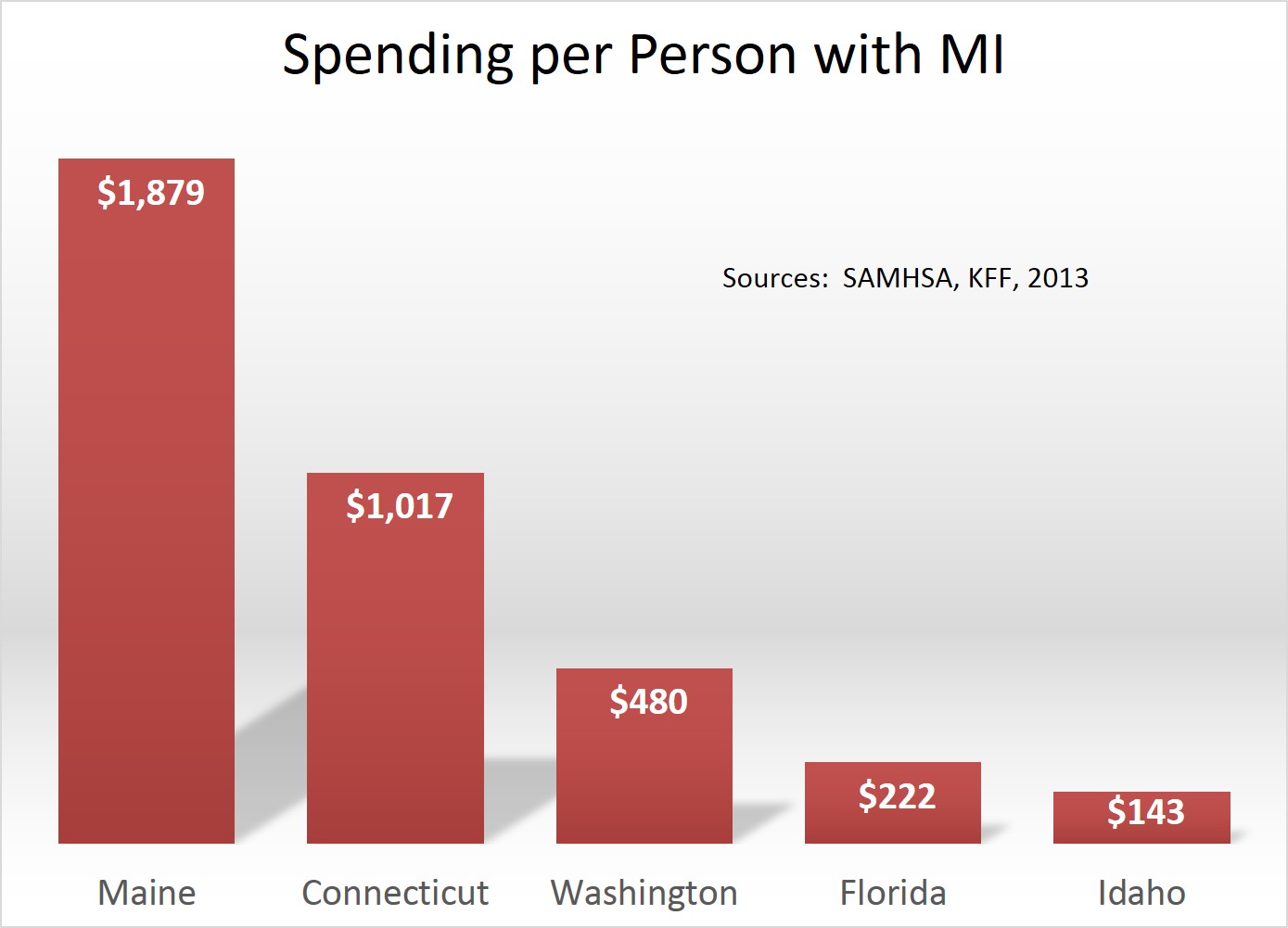
1. Maine.  Maine spends almost $1,900 per person with mental illness – 25 percent more than the next closest state.  It is tops in spending per capita, and but also 7th best in percentage in percentage of people reporting mental illnesses.

2. Alaska.  Alaska is middle-of-the-pack in prevalence, but it is second in spending per capita.  The result?  Alaska spends just under $1,500 per person with mental illness.

3. Pennsylvania.  Pennsylvania is 3rd overall in spending, but only 16thbest in prevalence.  That still results in spending of over $1,400 per person with mental illness.

4. New York.  New York is 4th in spending, and middle-of-the-pack in prevalence.  It spends over $1,200 per person with mental illness.

5. Vermont.  Like New York, Vermont is 23 places higher in spending than in prevalence.

6. New Jersey.  New Jersey is 3rd best in prevalence, but still spends over $1,100 per person with mental illness.

7. Arizona.  Arizona is only 36th best in prevalence, but it invests well in mental health services, spending $1,044 per person with mental illness.

8. Connecticut.  Connecticut is one of eight states that spend at least $1,000 per person with mental illness.  It pays off for a state that is tied with Georgia for 9th best in prevalence.

9. North Carolina.  North Carolina’s high ranking is driven by a 4th best ranking in prevalence, and top twelve spending per capita.

10. Hawaii.  Balance is the key to Hawaii’s ranking – 15th in prevalence and 10thin spending.

And the worst:

41. South Carolina. South Carolina ranks 23rdbest in prevalence, but is 43rd in spending.

42. Louisiana.  Louisiana is 35th in prevalence, but it is not enough to nudge up its overall ranking.

43. Utah. Utah is 49th in reported prevalence of mental illness – a surprise for a state that regularly ranks near the top in other health categories.  It spends only $263 per person with mental illness.

44. Kentucky.  Kentucky is middle-of-the-pack in prevalence, but spends only $259 per person with mental illness.

45. Georgia.  Georgia is tied with Connecticut for 9th best in prevalence, but it by spends only one-quarter as much per person with mental illness.

46. Oklahoma.  Oklahoma earns its ranking by placing 40th in prevalence and 45th in spending.

47. Florida.  Florida ranks second in prevalence, but only 48th position in spending per capita.  As a result, it spends just $222 per person with mental illness.

48. Texas.  Texas – which has the lowest prevalence of mental illness – still spends only $221 for each person with mental illness.

49. Arkansas.  Arkansas is one of only two states spending less than $200 per person with mental illness.  It is among the worst in both spending and prevalence.


50. Idaho.  Idaho is far and away the worst state for your mental health.  It is worst in reported prevalence and worst in reported spending.  How bad is Idaho?  At $143 per person, it spends less than one-tenth as much per person with mental illness as do Maine, Alaska, and Pennsylvania.

Paul Gionfriddo via email: gionfriddopaul@gmail.com.  Twitter: @pgionfriddo.  Facebook: www.facebook.com/paul.gionfriddo.  LinkedIn:  www.linkedin.com/in/paulgionfriddo/